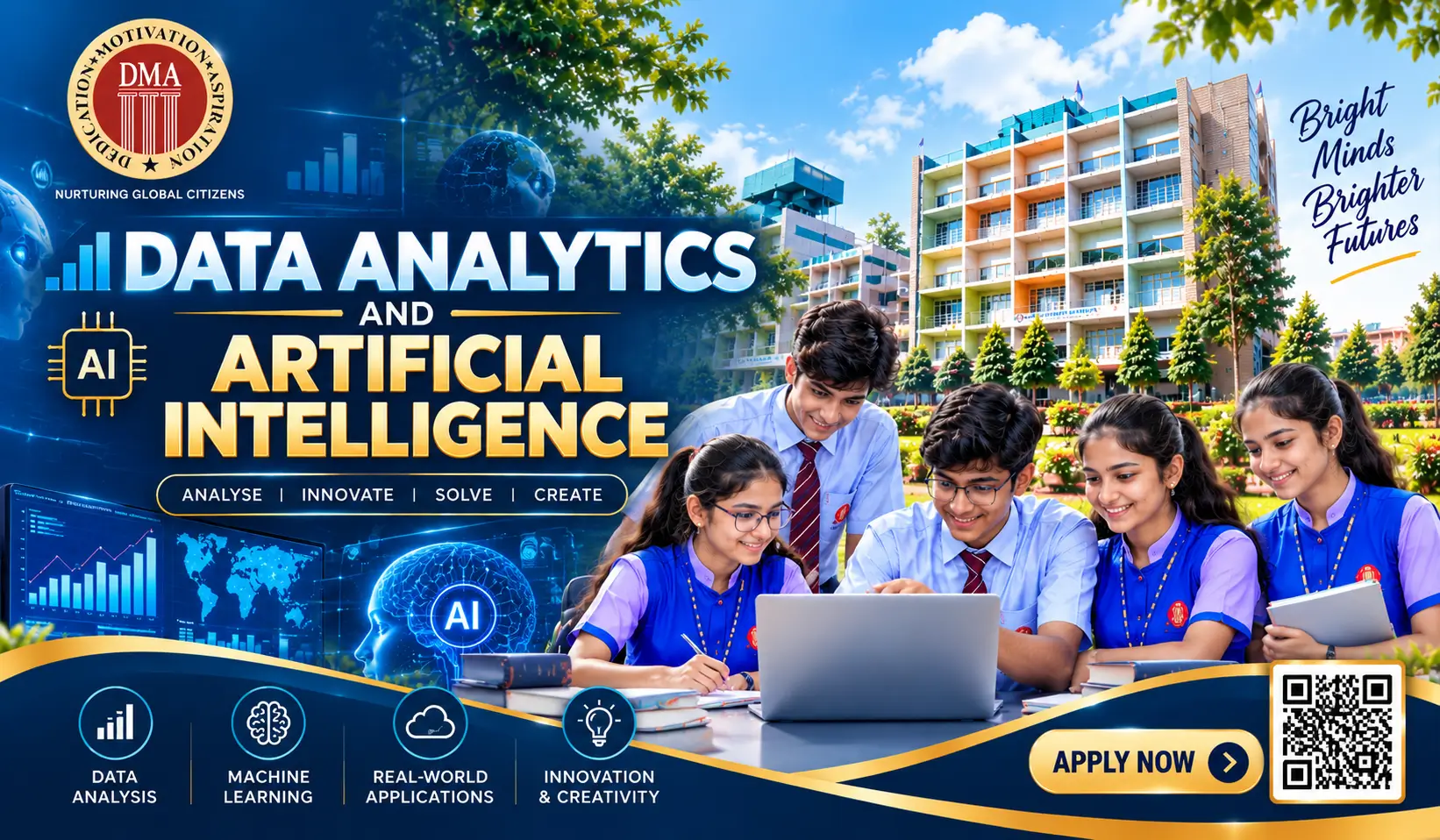
Data Analytics and Artificial Intelligence
- Categories Education Technology
Data Analytics and Artificial Intelligence
Transforming Information into Intelligence, and Intelligence into Impact
Quick Answer
Data Analytics and Artificial Intelligence (AI) are reshaping education and global industries. Analytics systematically uncovers insights from complex data, while AI extends our capacity to interpret patterns, make predictions, and generate content. Together, they enable responsive learning environments, empowering educators to move beyond uniform instruction to address the precise needs of every student, all while demanding responsible, human-centered oversight.
The future will not be shaped merely by those who possess the most data or the most powerful technology, but by those who know how to use both with wisdom, responsibility and purpose.
On This Page
- Introduction: A World at the Threshold of Transformation
- Data Analytics: Discovering the Story Behind the Numbers
- Artificial Intelligence: Expanding the Boundaries of Human Capability
- The Convergence: From Information to Intelligent Action
- Transforming Education: From Uniform Instruction to Responsive Learning
- Beyond the Classroom: Transforming Industries and Society
- The Ethical Imperative: Progress Without Losing Our Humanity
- The Future of Work: Redefining Human Competence
- Leadership in the Age of Intelligent Systems
- Conclusion: Intelligence Must Be Guided by Wisdom
Introduction: A World at the Threshold of Transformation
Human civilisation has advanced through successive revolutions in the way we produce, process and use information. The printing press democratised knowledge; the industrial revolution transformed production; the digital revolution connected the world. Today, we stand at the threshold of another profound transformation—one driven by Data Analytics and Artificial Intelligence (AI).
Every digital transaction, medical examination, classroom assessment, agricultural observation and online interaction generates information. Yet, information in isolation does not necessarily produce understanding. Its real value emerges when we can identify patterns, recognise relationships, anticipate possibilities and translate insights into meaningful action.
Data Analytics enables us to make sense of information. Artificial Intelligence extends our ability to interpret patterns, make predictions, generate content and support complex decisions. Together, they are reshaping industries, redefining professional roles and challenging established notions of knowledge, productivity and human capability.
For educators and institutional leaders, understanding this transformation is no longer optional. It is essential to preparing the next generation for a world in which technological fluency must coexist with critical thinking, ethical judgement, creativity and compassion.
Data Analytics: Discovering the Story Behind the Numbers
Data Analytics is the systematic process of collecting, organising, examining and interpreting data to uncover insights that can inform decisions.
Its significance extends far beyond the preparation of reports and statistical summaries. It enables individuals and organisations to move from intuition alone towards decisions supported by evidence.
Data analytics generally operates at four interconnected levels. Descriptive analytics explains what has happened; diagnostic analytics investigates why it happened; predictive analytics estimates what may happen next; and prescriptive analytics helps identify possible courses of action.
Consider a school experiencing declining enrolment. Descriptive analytics may reveal the decline, while diagnostic analysis may identify contributing factors such as transport costs, demographic changes or shifting parental preferences. Predictive analytics may help estimate future enrolment trends, and prescriptive analysis may support the evaluation of interventions.
The numbers, therefore, become more than records of the past. They become instruments for understanding the present and planning the future.
However, data must be interpreted in context. A correlation between two variables does not automatically establish a cause-and-effect relationship, and incomplete or inaccurate information can produce misleading conclusions. The purpose of analytics is not to replace judgement with numbers, but to make judgement better informed.
Artificial Intelligence: Expanding the Boundaries of Human Capability
Artificial Intelligence refers to computational systems designed to perform tasks associated with human intelligence, such as recognising patterns, processing language, analysing images, generating content and supporting decisions.
Machine learning enables systems to identify patterns from data. Deep learning uses layered computational models to recognise complex relationships. Natural language processing allows computers to work with human language, while computer vision enables the analysis of images and video. Generative AI can produce text, illustrations, audio, code and other forms of content in response to instructions.
These capabilities are already finding applications across sectors. AI-assisted systems can help analyse medical images, detect unusual financial transactions, forecast demand, support scientific research and improve industrial quality control.
Yet, AI should not be confused with human understanding. A system may generate a convincing response without possessing human experience, moral awareness or an independent understanding of the consequences of its recommendations. It may also produce inaccurate information or reflect biases embedded in its training data.
Consequently, the central question is not simply how intelligent a machine can become. It is how responsibly human beings can design, evaluate and use the intelligence that machines make available.
The Convergence: From Information to Intelligent Action
Data Analytics and AI are distinct but complementary disciplines. Analytics helps us understand evidence and derive insights; AI can learn patterns from data, generate predictions and assist in performing tasks. Their integration can create systems that are more responsive, adaptive and useful.
In business, historical sales data can be analysed to identify purchasing patterns, while AI models can help forecast demand and optimise inventory. In healthcare, the analysis of patient information may help clinicians identify trends, while validated AI tools can assist with particular diagnostic or administrative tasks. In manufacturing, data from machinery can support predictive maintenance, helping organisations identify potential equipment problems before a breakdown occurs.
These examples illustrate a common principle: data provides evidence, analytics develops understanding, and AI can help convert that understanding into timely action.
Nevertheless, the quality of an outcome depends on the quality of the underlying data, the suitability of the analytical model, the context in which it is deployed and the human oversight accompanying its use.
Technological sophistication is not, by itself, a guarantee of sound decision-making.
Transforming Education: From Uniform Instruction to Responsive Learning
Education offers one of the most meaningful opportunities to apply data analytics and AI constructively because every learner brings a distinctive combination of abilities, interests, circumstances and aspirations.
Traditional classroom practices have often depended on common instructional methods and periodic assessments. Although these remain important, they may not always reveal the precise difficulties a learner encounters or the kind of support that would be most effective.
Learning analytics can help educators examine assessment patterns, attendance, assignment completion and progress over time. When used carefully, these insights can help identify learning gaps, recognise areas of strength and direct additional support towards students who need it.
AI-assisted educational tools can help teachers develop differentiated learning resources, generate practice questions, explain difficult concepts in alternative ways and provide preliminary feedback. They may also support lesson planning, administrative work and the preparation of teaching materials, allowing educators to devote more time to meaningful interaction with students.
For example, if several students repeatedly struggle with a mathematical concept, an analysis of their responses may reveal a common misconception. A teacher can then redesign the explanation, introduce visual representations or provide additional practice. AI may assist in generating these resources, but the teacher determines which approach is pedagogically appropriate.
This is the promise of responsive education: not lowering expectations, but creating better pathways for learners to achieve them.
At the institutional level, analytics can support decisions concerning enrolment, student retention, staffing, resource allocation, infrastructure and programme effectiveness. Used responsibly, it can help school leaders move beyond assumptions and examine whether policies and interventions are producing the intended results.
Yet, an important distinction must remain clear. A student's academic performance is only one dimension of development. Curiosity, resilience, empathy, integrity, creativity and the ability to work with others cannot be adequately represented by examination scores alone.
No algorithm can fully measure the promise that lies within a child.
The purpose of AI in education must be to strengthen the teacher's ability to recognise and nurture that promise—not to reduce a learner to a collection of data points.
Beyond the Classroom: Transforming Industries and Society
The influence of data analytics and AI extends across almost every major sector of human activity.
Healthcare: Analytics can help researchers understand disease patterns, evaluate health trends and plan resources. AI tools may assist trained professionals in interpreting medical images and identifying patterns that warrant closer examination. Such applications require validation, privacy protection and clinical oversight.
Agriculture: Farmers and agricultural researchers can use weather information, soil measurements and satellite imagery to support decisions concerning irrigation, crop health and resource management. AI-based analysis can help interpret these varied sources of information, although outcomes depend on local conditions and data quality.
Banking and finance: Analytics helps institutions understand financial patterns, monitor risks and detect potentially suspicious transactions. AI can support fraud detection and customer services, but automated systems must be monitored for errors and unfair outcomes.
Manufacturing and commerce: Businesses can use operational data to improve quality control, anticipate maintenance needs, forecast demand and reduce waste. AI can support optimisation, provided that efficiency is balanced with worker safety and accountability.
Governance and environmental management: Data-driven analysis can help public institutions evaluate services, plan infrastructure and study environmental changes. AI may assist in processing large datasets, supporting better-informed decisions about resource management and sustainability.
Across these fields, the underlying opportunity is remarkably consistent: technology can help people identify problems earlier, allocate resources more intelligently and explore solutions that might otherwise remain undiscovered.
Its benefits, however, are not automatic. They depend on accessibility, expertise, responsible implementation and a clear understanding of whose interests the technology is intended to serve.
The Ethical Imperative: Progress Without Losing Our Humanity
Every powerful technology introduces responsibilities alongside opportunities. Data analytics and AI are no exceptions.
Privacy is a fundamental concern because personal information, once collected, can be misused, exposed or retained beyond its legitimate purpose. Institutions must establish clear rules governing what data they collect, why they collect it, who can access it and how it is protected.
Bias is another significant challenge. When datasets fail to represent different communities fairly, the resulting systems may reproduce existing inequalities. An apparently objective algorithm can therefore produce outcomes that are neither neutral nor just.
Accuracy and accountability are equally important. AI-generated content may contain fabricated facts, misleading explanations or unsupported conclusions. Decisions affecting education, employment, healthcare and access to public services must not be accepted merely because they have been generated by sophisticated software.
There is also the danger of overdependence. If students routinely delegate thinking and problem-solving to AI, they may lose opportunities to develop the very capabilities that education is intended to cultivate. Similarly, professionals who accept automated recommendations without questioning them may surrender their responsibility to exercise independent judgement.
The response must be a culture of responsible innovation. Institutions should validate the tools they adopt, protect personal information, establish clear accountability and retain meaningful human oversight. Students and professionals must learn to verify outputs, question assumptions and recognise the limitations of technological systems.
The Organisation for Economic Co-operation and Development's AI Principles emphasise trustworthy AI that respects human rights and democratic values. UNESCO's guidance on generative AI in education and research similarly advocates a human-centred approach that protects privacy, promotes inclusion and safeguards human agency.
These principles remind us that technological progress must be evaluated not only by what it makes possible, but also by the consequences it creates.
The Future of Work: Redefining Human Competence
As AI automates or assists with an increasing range of tasks, the nature of work will continue to evolve. Some existing responsibilities may diminish, others may be transformed, and new roles will emerge. The pace and impact of these changes will vary across professions and economies.
The appropriate response is not to prepare young people for a fixed list of occupations that may change before they enter the workforce. It is to equip them with the ability to learn, adapt and think independently throughout their lives.
Digital literacy, data interpretation, computational thinking and AI awareness will become increasingly valuable. Equally important will be communication, collaboration, creativity, emotional intelligence, ethical reasoning and the capacity to solve unfamiliar problems.
The future professional will need to understand not only how to use intelligent tools, but also when to question them, when to reject their recommendations and when human intervention is indispensable.
For educational institutions, this calls for a curriculum that connects scientific understanding with real-world applications, encourages interdisciplinary inquiry and provides opportunities for students to investigate authentic problems.
Technology should not merely be another subject to learn. It should become a means through which learners explore, create, question and contribute.
Leadership in the Age of Intelligent Systems
The integration of analytics and AI requires more than the purchase of software or the installation of digital infrastructure. It requires a thoughtful transformation of institutional culture.
Leaders must identify the problems they wish to solve before selecting technological solutions. They must ensure that the data available is relevant and reliable, that staff members receive appropriate training, and that outcomes are evaluated against clearly defined objectives.
In schools, for instance, the success of an AI initiative should not be judged simply by the number of tools introduced or the speed with which tasks are completed. It should be assessed by whether teaching improves, students learn more effectively, teachers receive meaningful support and institutional decisions become better informed.
Leadership must also recognise that technological adoption is a human process. Teachers may need time to develop confidence, students require guidance in responsible use, and parents deserve clarity about how educational data is handled.
The most effective leaders will be those who combine analytical discipline with empathy, innovation with prudence, and measurable goals with an unwavering commitment to human development.
Conclusion: Intelligence Must Be Guided by Wisdom
Data Analytics and Artificial Intelligence are changing the way the world understands information and acts upon it. They offer powerful opportunities to improve services, accelerate discovery, strengthen decision-making and address complex challenges across education, healthcare, agriculture, commerce and governance.
But the ultimate measure of progress cannot be the volume of data processed, the sophistication of an algorithm or the speed of automation. It must be the difference these technologies make to human lives.
Data can reveal patterns, analytics can deepen understanding, and AI can expand our capacity to generate solutions. Yet, deciding what is fair, meaningful and worthy of pursuit remains a profoundly human responsibility.
For education, this distinction is particularly important. We must prepare learners not merely to compete in an AI-driven world, but to shape that world with integrity, imagination and compassion.
The challenge before us is not to choose between human intelligence and artificial intelligence. It is to build a future in which each complements the other, technological capability is matched by ethical responsibility, and innovation serves the larger cause of human progress.
The defining achievement of the AI era will not be that machines learn to perform more tasks independently, but that humanity learns to use its expanding technological power more wisely.
Frequently Asked Questions
How do Data Analytics and AI work together?
What is responsive learning in education?
Why is human oversight crucial when using AI?
What skills will students need for the future workforce?
Preparing Students for an Intelligent Future
At Dayawati Modi Academy, we believe in integrating technological fluency with critical thinking and compassion. Discover how our curriculum empowers the next generation.
Explore Our Curriculum
Official updates, results, and insights from Dayawati Modi Academy — Best CBSE School in Meerut since 1981.