
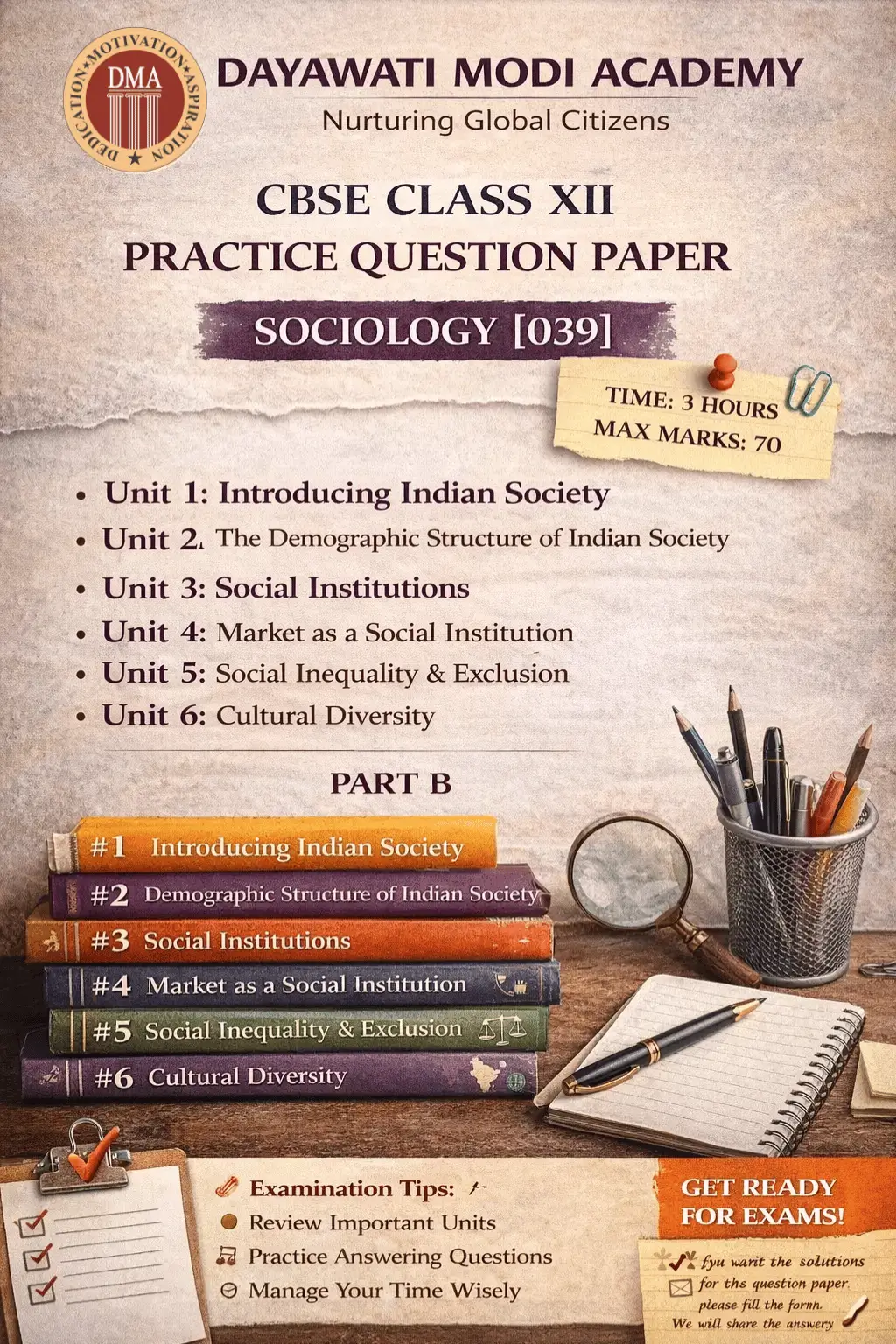
PRACTICE QUESTION PAPER
SOCIOLOGY [039]
Unit 1: Introducing Indian Society
- Define ‘Sanskritization’. Discuss its features and critique.
- Explain the difference between Western and Indian notions of secularism.
- How did the colonial period impact tribal identity in India?
- Discuss the concept of ‘patriarchy’ in Indian society.
Unit 2: The Demographic Structure of the Indian Society
- Highlight the major features of India’s population distribution.
- Explain the social implications of a high percentage of the young population in India.
- Discuss the gender ratio in the Indian context and its social significance.
- Describe the socio-economic factors affecting population growth.
Unit 3: Social Institutions
- Define family. Distinguish between nuclear and joint families, highlighting their pros and cons.
- Discuss the changing nature of the institution of marriage in India.
- Describe the main features and functions of kinship.
- How does the caste system in India adapt and change over time? Discuss with examples.
Unit 4: The Market as a Social Institution
- Describe the difference between barter and monetary economies.
- Discuss the social implications of globalisation in India.
- How has the Green Revolution transformed the agrarian structure in India?
- Explain the rise and challenges of consumerism in modern Indian society.
Unit 5: Patterns of Social Inequality and Exclusion
- Highlight the various dimensions of social inequality in India.
- Discuss the challenges faced by the scheduled castes in contemporary India.
- Explain the concept of ‘minority’ and the issues they face in India.
- Describe the status and rights of Adivasis in India.
Unit 6: The Challenges of Cultural Diversity
- Discuss the linguistic diversity of India and its implications.
- How does religion influence the cultural patterns of Indian society?
- Describe the issues arising from regionalism in India.
- How does the Indian state respond to the challenges of cultural diversity?
Unit 7: Suggestions for Project Work
- Describe a project work you’ve undertaken to understand a specific cultural practice in your region.
- Discuss your experience and learnings from a field trip related to sociology.
PART B
Unit 1: Structural Change
- What is ‘modernisation’ in the context of post-colonial India?
- Describe the societal impact of the introduction of the railways in India.
- How did land reforms post-independence aim at altering structural inequalities?
- Discuss the major shifts in India’s economic policies post-1991.
Unit 2: Cultural Change
- How has globalisation influenced Indian cultural traditions?
- Describe the process of ‘Westernisation’ in India.
- What role does mass media play in accelerating or moderating cultural change?
- Explain the concept of ‘Sanskritization’ and its implications on cultural change.
Unit 3: The Story of Indian Democracy
- Highlight the primary challenges faced by Indian democracy since independence.
- What has been the role of social movements in the evolution of Indian democracy?
- Discuss the significance of the 73rd and 74th amendments in the Indian Constitution.
- How have regional parties influenced the trajectory of Indian democracy?
Unit 4: Change and Development in Rural Society
- What were the major outcomes of the Green Revolution in India?
- Describe the socio-economic challenges faced by contemporary rural labour.
- How did land reform policies intend to transform agrarian structures?
- Discuss the role of microfinance in rural development.
Unit 5: Change and Development in Industrial Society
- Trace the evolution of industrialisation in India post-independence.
- How have IT industries reshaped urban landscapes in India?
- What are the major challenges faced by industrial labour in India?
- Discuss the significance of the informal sector in the Indian industrial landscape.
Unit 6: Globalization and Social Change
- Define globalisation and discuss its major implications for India.
- How has globalisation impacted the artisanal sectors in India?
- Discuss the socio-cultural repercussions of the rise of multinational corporations in India.
- What have been the major resistances or criticisms against globalisation in the Indian context?
Unit 7: Mass Media and Communications
- How has mass media influenced societal values and beliefs in India?
- Discuss the shift from traditional to digital media and its implications.
- What role does media play in shaping political narratives in India?
- Describe the challenges and opportunities posed by the digital revolution in media.
Note:
If you want the solutions for this question paper, please fill the form.
We will share the answers with you.
If you want the solutions for this question paper, please fill the form.
We will share the answers with you.